
Keep out of the affected area
- Keep children and pets away from the area entirely.
- Do not run fans in the space. Moving air spreads contamination through the house.
- Do not attempt to extract it with household equipment.
- Avoid using drains and fixtures on that line until the cause is identified.
- Photograph the extent before anything is moved.
Why sewage is a different job
With clean water, the problem is moisture and the goal is to get materials back to normal. With sewage, moisture is the secondary issue. The water carries bacteria and organic material that soak into porous surfaces and stay there after the water is gone. Extracting and drying a carpet that has been through a sewage backup returns it to normal moisture while leaving the contamination in place.
That single fact drives the whole approach. Rather than asking what can be dried, the work asks what can be cleaned all the way through. Material that can only be cleaned on the surface comes out.
How the work proceeds
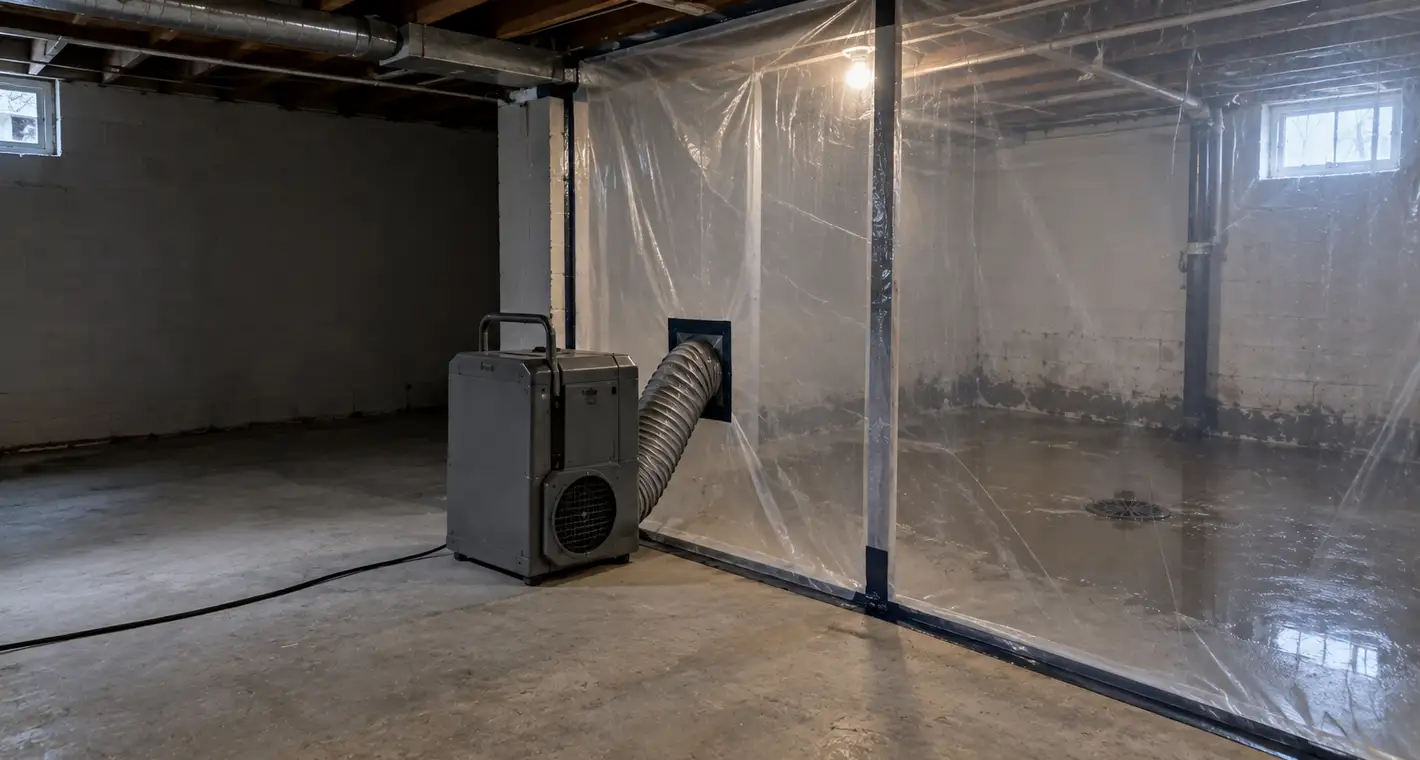
The area is contained before anything is removed. Openings to the rest of the house are sheeted off and the work zone is put under negative pressure, so air flows into it and is filtered on the way out rather than carrying contamination into clean parts of the home. Skipping this step means the removal itself distributes the problem.
Affected porous material is then removed and bagged. That typically means carpet and padding, the lower band of drywall, wet insulation, particleboard, and laminate or engineered flooring. Non-porous material such as concrete, tile, sealed hardwood and structural framing can usually be cleaned and kept, since contamination stays on the surface where it can be reached.
Cleaning follows removal, and only after cleaning does the structure get dried in the ordinary way, with air movers and dehumidification under moisture readings. Drying before cleaning would set contamination into the materials being dried.
Sewer backup cleanup Warren MI: where these losses start
Combined sewers on both flanks
Ferndale, Hazel Park, Royal Oak, Madison Heights and part of Troy put rain and sewage in one pipe running to the George W. Kuhn basin at Twelve Mile. Eastpointe, Roseville and St. Clair Shores do the same toward the Chapaton and Martin basins on Lake St. Clair. In both systems a heavy hour of rain raises the level in the line your basement drain connects to.
Groundwater leaking into separate systems
Warren, Sterling Heights and Fraser keep sewage in its own pipe, which should make them immune. They are not. Rain reaches the sanitary line anyway, through cracked clay laterals, old footing-drain connections and downspouts tied into the wrong pipe, and the line fills from upstream. Warren opened a 22-million-gallon holding basin in February 2025 specifically to absorb that surge.
Roots in laterals laid in one decade
When a city is platted in a single decade, its private laterals all reach the end of their life together. Clay pipe from the 1950s runs a short distance under a driveway and a street tree, and root intrusion at the joints is the norm. That blockage backs up on a laundry day with no rain, which is how it is told apart from a surcharged public main.
Sewage backup cleanup by city
- Flooded Basement Cleanup WarrenZIP 48088, 48089, 48091, 48092, 48093
- Water Damage Restoration Sterling HeightsZIP 48310, 48312, 48313, 48314
- Water Damage Restoration St. Clair ShoresZIP 48080, 48081, 48082
- Water Damage Restoration TroyZIP 48083, 48084, 48085, 48098
- Water Damage Restoration Royal OakZIP 48067, 48073
- Water Damage Restoration EastpointeZIP 48021
- Water Damage Restoration RosevilleZIP 48066
- Water Damage Restoration FraserZIP 48026
- Water Damage Restoration Madison HeightsZIP 48071
- Water Damage Restoration FerndaleZIP 48220
- Water Damage Restoration Hazel ParkZIP 48030
Sewage backup cleanup Warren MI: questions we are asked
- Why can sewage water not simply be extracted and dried?
- Because the concern is contamination rather than moisture. This is category 3 water, and it carries bacteria and organic material that remain in porous surfaces after the water itself is gone. Drying a saturated carpet returns it to normal moisture but does nothing about what soaked into it, which is why porous material affected by sewage is removed rather than dried.
- What has to be removed after a sewage backup?
- Generally carpet and padding, the lower band of drywall, wet insulation, particleboard and any laminate or engineered flooring the water reached. Non-porous surfaces such as concrete, tile, sealed hardwood and framing can usually be cleaned and kept. The dividing line is whether the material can be cleaned all the way through or only on the surface.
- Is a backup from a clean toilet treated the same way?
- Water from a toilet overflow that has not passed the trap is a lesser category and is handled less aggressively. Once water has come back up from the lateral or the main, or has passed through the trap, it is treated as contaminated regardless of how it looks or smells. Describe what actually happened when you call, since the two get very different responses.
- How is the rest of the house kept clean during the work?
- The affected area is contained before removal starts, usually with sheeting over openings and negative air pressure inside the work zone so air flows into it rather than out into the rest of the home. Material comes out bagged. Without containment, the removal itself distributes contamination through the house.
- Why is a floor drain backup always the one in the basement?
- Because in a full-basement house that drain is the opening closest to the floor on the whole property, and a pipe under pressure releases at the first opening it can reach. Everything above it — the ground-floor toilet, the tub, the kitchen sink — is protected simply by being higher. That is also why a slab-built house in another state shows the same failure at a shower pan instead.
- The laterals on my street are seventy years old. Does that matter?
- It matters twice. A clay lateral of that age has open joints that let roots in, and that is what blocks your own line on a laundry day with no rain. The same open joints let groundwater into the public system during a storm, which is a large part of what fills the sanitary sewer and pushes it back into somebody's basement. The pipe is both a victim and a cause.