
Emergency water removal Roseville: the ground and what is built on it
Roseville sits between Warren and the lake shore, flat and fully platted, straddling Gratiot Avenue. Its combined sewage runs east with Eastpointe and St. Clair Shores to the retention basins on Jefferson rather than north into the Red Run. A third of the housing dates from the 1950s and another fifth from the 1960s, giving a median year built of 1961. Owner occupancy is sixty-six percent, below the rest of the cities covered here, and much of the stock is small brick ranches and two-family houses over full basements.
Before help arrives
- Shut the water off at the fixture or the main if you can reach it safely.
- Keep out of any room where water has reached outlets, cords, or the electrical panel.
- Lift furniture off wet carpet and move what you can to a dry floor.
- Photograph the damage and the failure point before anything is moved.
- Do not use a household vacuum to pick up standing water.
Common causes of water damage in Roseville
Shared capacity with two other cities
Roseville belongs to the Southeast Macomb Sanitary District together with Eastpointe and St. Clair Shores, and its flow reaches the Martin basin on Jefferson. The state reclassified that basin as a combined sewer overflow facility, and a relief sewer project is meant to cut its overflows by about sixty percent. Until that is finished, a heavy hour of rain still surcharges the line under your street, and sewage backup cleanup Roseville arrives on several blocks at once.
Two-family houses with one lateral
A good share of the older stock here was built or converted as a two-family with a single sewer lateral serving both units. Twice the fixtures and twice the laundry go through a seventy-year-old clay pipe. When it backs up, both units flood, and the responsibility for the private side of the line is often unclear until someone has to pay for it.
Floor drains as the release point
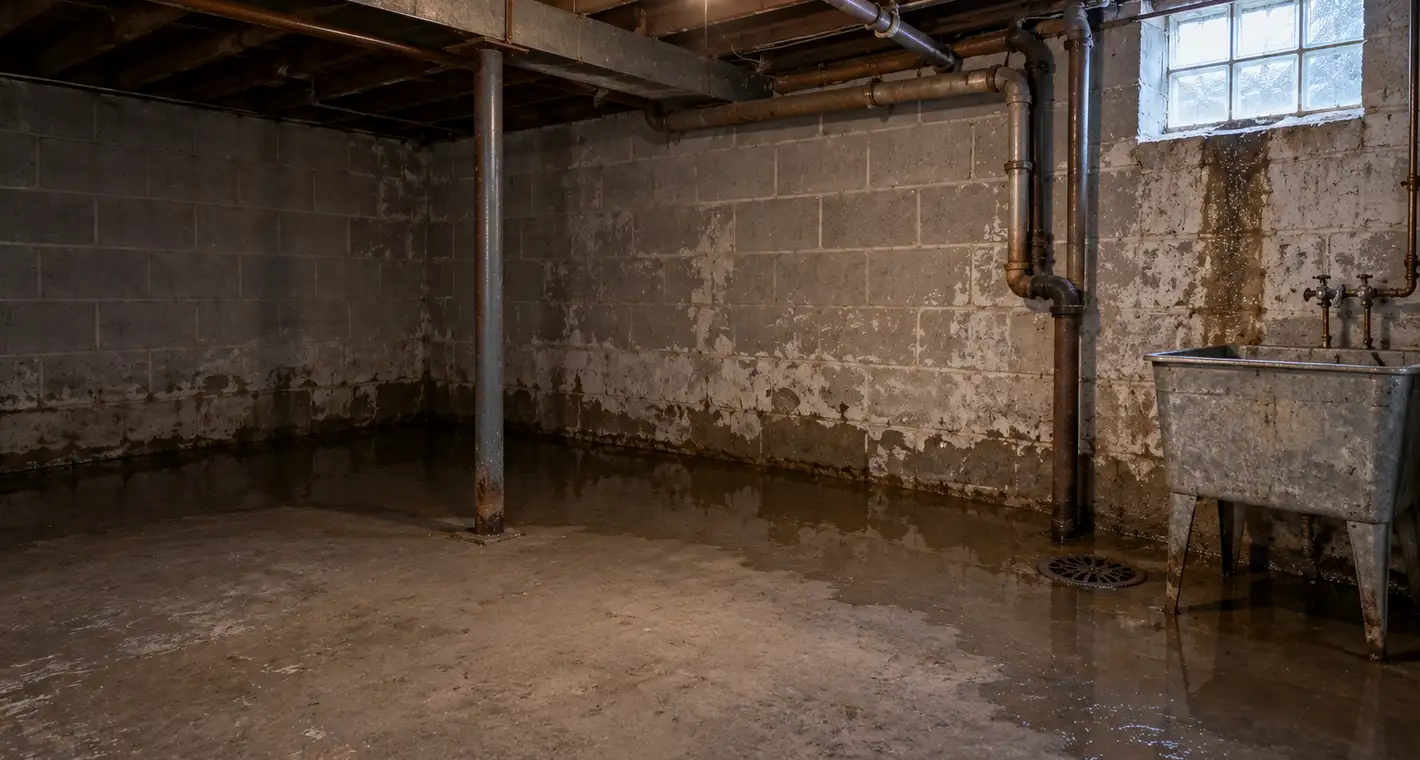
On these blocks the basement floor drain is the opening closest to the floor on the whole property, so it is where the public line releases first. Householders discover that the drain has been under a workbench or a storage shelf for years. Emergency water removal Roseville often begins with clearing the room enough to find the drain that is doing the flooding.
Water heaters at the end of their run
Tanks last ten to fifteen years, and a housing stock this uniform in age tends to replace them in waves. A tank that opens at the seam empties forty or fifty gallons onto a basement floor and keeps feeding from the supply until someone closes the valve. Burst pipe cleanup Roseville and water heater failures together account for most of the losses here that have nothing to do with rain.
Burst pipe cleanup Roseville, and drying what it leaves behind
Basements here are working spaces: laundry, freezer, workshop, sometimes a finished corner. That means porous stored contents, cardboard and particle-board furniture that wick water and hold it against the wall. Contents get moved or discarded before drying starts, because a room full of wet boxes will not reach a dry reading no matter how long the equipment runs.
The full sequence, and how drying is confirmed rather than assumed, is set out on the water extraction and drying page.
Water damage and mold services in Roseville
- Water Extraction & DryingStanding water removal and controlled structural drying under daily moisture readings.
- Basement Flood CleanupBelow-grade water: sump failures, sewer surcharge, seepage through block walls.
- Sewage Backup CleanupContaminated water from floor drains and laterals, handled under containment.
- Mold RemediationGrowth that took hold after water sat longer than it should have.
Areas covered in Roseville, MI
Providers cover Roseville and the surrounding area, including the Gratiot corridor, the Macomb Mall area, Utica Road, Little Mack, Common Road and the Twelve Mile blocks.
Water Damage Restoration Roseville, MI: questions we are asked
- Both units in my two-family flooded. Is that one claim or two?
- Physically it is one event with one cause, usually the shared lateral or the public main. How it is handled depends on ownership and on the policies involved, and that is a question for the insurers rather than for the restoration crew. What matters on site is that both units are documented separately before anything is moved, with photographs of the water line on the wall in each.
- How do I know whether it was my lateral or the city main?
- Timing and company. A blockage in your own lateral backs up whenever enough water is used inside, often on laundry day with no rain at all. A surcharged main backs up during or just after heavy rain and does the same thing to your neighbors at the same hour. If several houses on the street flooded together, the cause was not in any one of their laterals.
- Does water damage restoration Roseville MI cover the contents as well?
- Contents are handled alongside the structure but by different rules. Hard non-porous items are cleaned; porous items that absorbed contaminated water are removed. In a basement used for storage this is most of the volume, and the honest answer is that a large share of what is down there does not survive a category three loss. Photographing everything before removal is the part people regret skipping.
- Is mold remediation Roseville a separate job?
- It becomes one when growth is already established, because the method changes. Drying wet material is done in the open; removing grown material is done under containment with the work area sealed and air filtered, so that spores are not moved through the rest of the house. A loss addressed within the first days usually stays a drying job and never crosses that line.
- Who is responsible for the sewer line at my Roseville house?
- The public main under the street belongs to the city; the lateral running from the house to that main is generally the property owner's, including the portion under the front lawn. That split matters after a backup, because a root-blocked lateral is a private repair while a surcharged main is a capacity event. A camera inspection after the cleanup is what tells the two apart, and it is worth doing before rebuilding anything.