
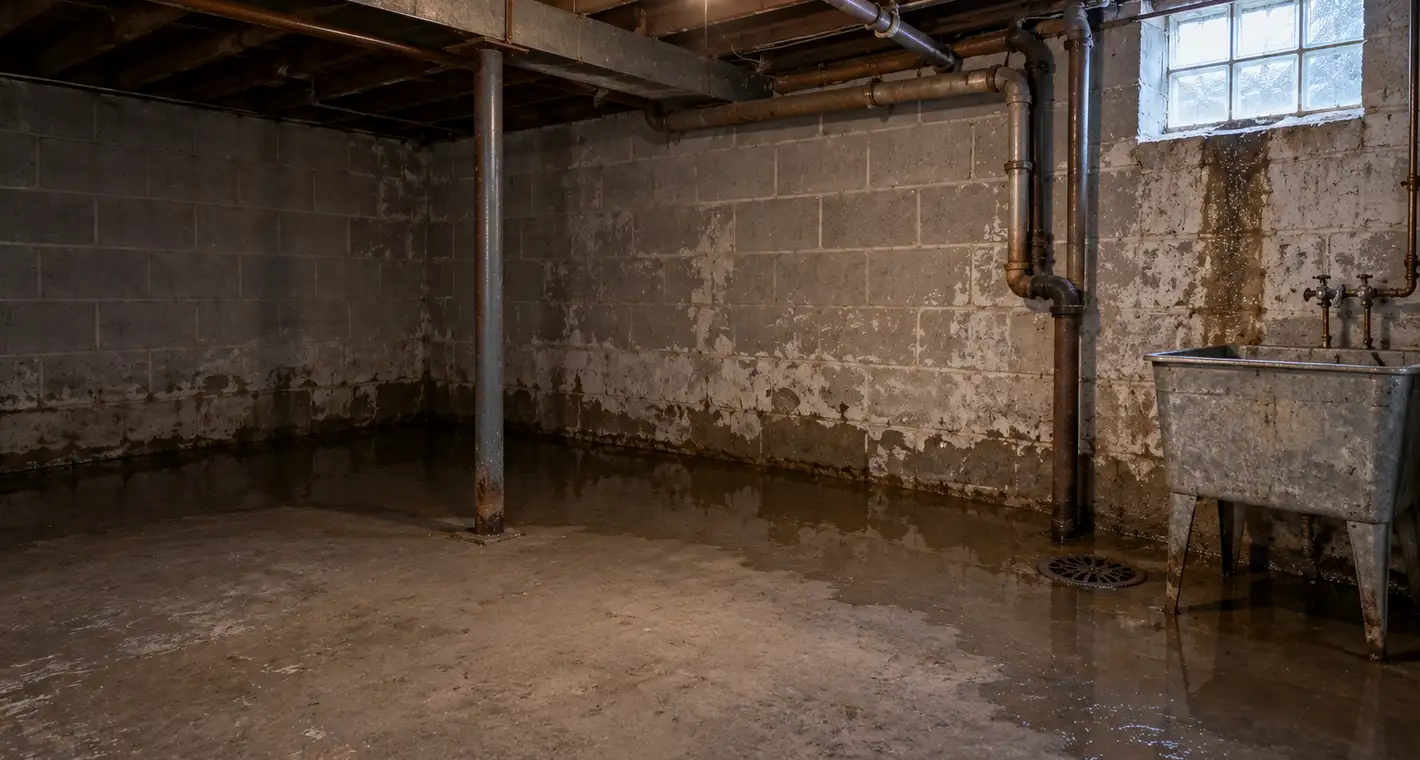
Emergency water removal St. Clair Shores: the ground and what is built on it
The city runs five miles along Lake St. Clair, and the eastern blocks are cut by residential canals that open onto it. Ground level near the water is only a few feet above lake level, which puts the water table close under a full-depth basement floor. Half of every house in the city was built in the 1950s, one decade doing more than all the others combined, and the median year built is 1957. Owner occupancy is eighty-three percent, the highest in the coverage area, and the standard house is a brick bungalow or ranch on a narrow lot.
Before help arrives
- Shut the water off at the fixture or the main if you can reach it safely.
- Keep out of any room where water has reached outlets, cords, or the electrical panel.
- Lift furniture off wet carpet and move what you can to a dry floor.
- Photograph the damage and the failure point before anything is moved.
- Do not use a household vacuum to pick up standing water.
Common causes of water damage in St. Clair Shores
A combined sewer that carries both
Unlike Warren, this city puts street water and household waste in the same pipe, and both run to retention basins on Jefferson. The Chapaton basin at the foot of Nine Mile holds around 28 million gallons from here and Eastpointe; the Martin basin was reclassified by the state as a combined sewer overflow facility. When both fill, the surge has nowhere to go but back up the laterals.
Lake level, not rainfall
Lake St. Clair set record highs in 2019 and again in 2020, and ground within a few blocks of the shore stayed saturated for two seasons. A high lake raises the water table under the whole eastern half of the city, so basements take seepage through the wall-floor joint on dry days. Emergency water removal St. Clair Shores crews see this one in spring, with no storm attached to it.
Seventy-year-old laterals under mature trees
Clay sewer laterals laid in the 1950s sit under boulevards planted at the same time, and the roots go where the water is. A root mass in the lateral does not block it outright; it catches paper until a wash day fills the line. The backup arrives through the basement floor drain, and sewage backup cleanup St. Clair Shores follows the same handful of streets year after year.
Canal walls and boat-well seepage
Houses on the canals have a seawall a few feet from the foundation and a water surface that moves with the lake. Where a seawall has failed, soil behind it stays wet and the pressure on the basement wall never drops. It shows up as a damp block wall on the canal side of the house and nothing on the street side, which is how you tell it from a plumbing failure.
Burst pipe cleanup St. Clair Shores, and drying what it leaves behind
Basements here are shallow-poured block with tile or paint on the floor and a lot of original paneling still in place. Where the water was contaminated the paneling comes off regardless of how it looks, because the framing behind it holds the contamination. On the canal side, drying without addressing the outside water simply resets the clock. Burst pipe cleanup St. Clair Shores in winter is a separate pattern, on supply lines run along an outside wall in an unheated basement.
The full sequence, and how drying is confirmed rather than assumed, is set out on the water extraction and drying page.
Water damage and mold services in St. Clair Shores
- Water Extraction & DryingStanding water removal and controlled structural drying under daily moisture readings.
- Basement Flood CleanupBelow-grade water: sump failures, sewer surcharge, seepage through block walls.
- Sewage Backup CleanupContaminated water from floor drains and laterals, handled under containment.
- Mold RemediationGrowth that took hold after water sat longer than it should have.
Areas covered in St. Clair Shores, MI
Providers cover St. Clair Shores and the surrounding area, including the Nautical Mile, the canal blocks off Jefferson, the Harper Avenue corridor, Blossom Heath, Lakeview and the Masonic corridor.
Water Damage Restoration St. Clair Shores, MI: questions we are asked
- What does a combined sewer mean for my house?
- It means the pipe under your street carries rain and sewage together, so a heavy hour of rain raises the level in the same line your basement drain connects to. That is why a backup here can be contaminated even though nothing went wrong inside the house. Communities on separate systems a few miles inland have the same rain and a different failure.
- Does a backwater valve solve it?
- It stops the public line from pushing back into the house, which is the failure that does the damage here, and many local plumbers install them for exactly this reason. It does not help with water arriving through the wall or with a fixture that overflows on your side of the valve, and a valve that is never inspected can seize open. Treat it as one layer rather than the answer.
- Is water damage restoration St. Clair Shores MI different on the canals?
- The work is the same; the diagnosis is not. On a canal lot the first question is whether the seawall and the soil behind it are holding, because a wet basement wall on the water side with a dry street side points outward rather than at the plumbing. Drying equipment on a house with a failing seawall runs and runs without the readings moving.
- How quickly does mold remediation St. Clair Shores become necessary?
- Faster in a lakeside basement than in an inland one, because the ambient humidity down there rarely drops on its own. Material that would air-dry over a week in a drier basement stays at a growth-supporting moisture content here. That is the argument for putting a dehumidifier on the space immediately rather than waiting to see whether it dries by itself.
- Why does my basement get damp when it has not rained?
- Near the lake the water table moves with the lake rather than with the weather. Lake St. Clair set monthly records through 2019 and 2020, and ground on the eastern blocks stayed saturated for two seasons afterwards. A wall that is damp along the bottom band on a dry week is being pushed from outside. Drying the room helps for a few days; the moisture returns until the outside water drops or is intercepted.