
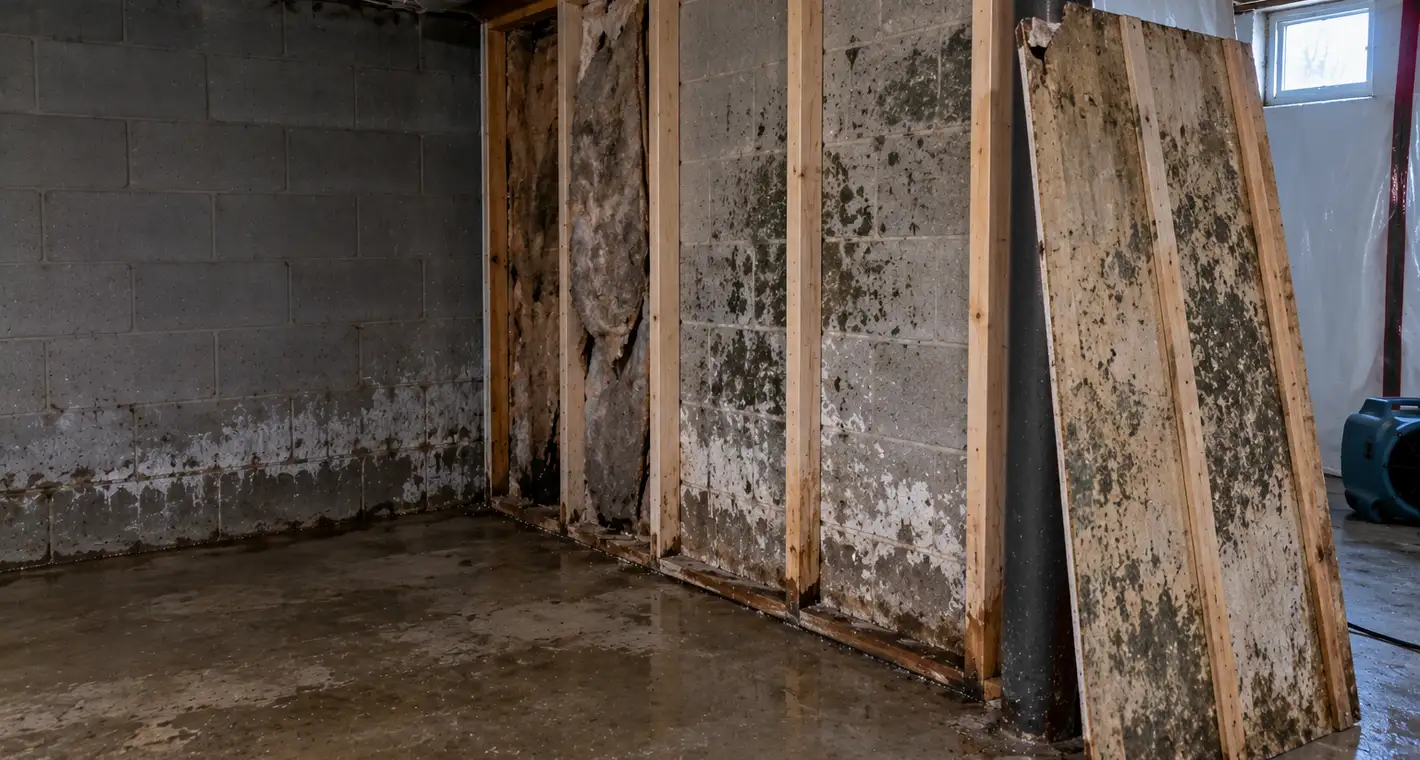
Black mold, basement walls, and where the moisture actually comes from
Mold needs moisture, an organic food source, and moderate temperature. Building materials supply the second and indoor living supplies the third, so moisture is the only variable that can actually be controlled. In practice that means growth in a home nearly always traces back to water that stayed somewhere longer than it should have.
In this coverage area the moisture almost always arrives below grade, and five sources account for most of it. Seepage through an unsealed block wall in a house built before perimeter drain tile was standard. A sump pit that overflowed because the power was out or the discharge line was frozen. A sewer surcharge that came up through the floor drain during a storm. A finished basement framed against block that was never drained from the outside. And meltwater from an ice dam at the eaves, which runs down inside a wall in February and is not found until spring.
The climate here works against a basement in both seasons, which is why airing one out is poor advice. Michigan summers carry high dew points, so outdoor air drawn into a cool basement gives up its moisture onto the walls and the slab rather than removing any: opening the windows makes the room wetter. In winter the outdoor air is dry, but the basement is cold, and surfaces sit close enough to the dew point that condensation forms on block and on cold water lines. Neither season dries a wet basement on its own. Mechanical dehumidification does, and that is the difference between a loss that stops and one that turns into remediation.
Mold removal Warren MI: how remediation is carried out
The work begins by finding the moisture source and the extent of the growth, because remediating without correcting the source produces a repeat. Moisture meters and thermal imaging are used to establish how far water traveled through the assembly, which is regularly further than the visible staining suggests.
The work area is then contained. Openings are sheeted off and the zone is held under negative pressure with filtered air movement, so that air flows into the containment rather than out of it. This matters because removal disturbs spores, and without containment ordinary air movement carries that disturbance into rooms that had no problem.
Affected porous material is removed under containment and bagged before it leaves the work area. Drywall, insulation, carpet, padding and particleboard are the usual candidates, since growth extends into the material rather than resting on its surface. Non-porous and semi-porous surfaces such as framing, concrete and tile can generally be cleaned in place, and framing is often treated after cleaning.
Once removal and cleaning are finished, the assembly is dried under moisture readings in the same way as any water loss, and the underlying cause is addressed. Where verification is wanted, it is normally performed by an independent party rather than by whoever did the work.
Water damage and mold are one sequence
These are not two unrelated services. Almost every remediation job in a home began as a water event that was either not found quickly or not dried completely. Growth commonly begins within a couple of days of materials becoming wet, which is why extraction and drying are treated as urgent and why drying equipment is left in place until readings confirm the structure is genuinely dry rather than dry to the touch.
If your property has taken on water recently and has not been dried under measurement, addressing it as a water loss now is a smaller undertaking than addressing it as a remediation job later.
Mold remediation by city
- Flooded Basement Cleanup WarrenZIP 48088, 48089, 48091, 48092, 48093
- Water Damage Restoration Sterling HeightsZIP 48310, 48312, 48313, 48314
- Water Damage Restoration St. Clair ShoresZIP 48080, 48081, 48082
- Water Damage Restoration TroyZIP 48083, 48084, 48085, 48098
- Water Damage Restoration Royal OakZIP 48067, 48073
- Water Damage Restoration EastpointeZIP 48021
- Water Damage Restoration RosevilleZIP 48066
- Water Damage Restoration FraserZIP 48026
- Water Damage Restoration Madison HeightsZIP 48071
- Water Damage Restoration FerndaleZIP 48220
- Water Damage Restoration Hazel ParkZIP 48030
Mold remediation Warren MI: questions we are asked
- How quickly can mold establish after water damage?
- Given moisture, an organic food source such as paper-faced drywall, and ordinary indoor temperatures, growth can begin within a couple of days. That window is the reason drying is treated as urgent rather than something that can wait for the weekend. Water damage handled promptly frequently prevents the second problem entirely.
- Should I book a mold inspection Warren first?
- Testing has a place but it is not always the first step. Where growth is visible and the water source is known, the finding rarely changes what has to be done. Testing is more useful where there is an odor or a suspected problem with no visible growth, where the extent behind an assembly is unclear, or where an independent verification after the work is wanted. Post-remediation verification is normally done by someone other than the party performing the work.
- Can I clean it myself with bleach?
- For a small patch on a hard, non-porous surface such as tile or glass, ordinary cleaning is often reasonable. On porous material it is not, because growth extends into the material where a surface treatment cannot reach, and wiping it disturbs spores into the air of the rest of the house. Bleach on porous surfaces also adds water, which is the thing feeding the problem.
- Why is containment used?
- Removing affected material disturbs spores. Without sheeting and negative air pressure holding the work zone under lower pressure than the rest of the house, that disturbance is carried through the home by ordinary air movement, and a contained problem becomes a distributed one. Containment protects the parts of the house that were fine.
- Will it come back?
- It will if the moisture that caused it is still present. Remediation removes what has grown, but the condition that allowed it has to be corrected too: the leak repaired, the drainage fixed, the humidity brought down, the affected assembly properly dried. Work that removes growth without addressing the moisture source tends to be repeated.