
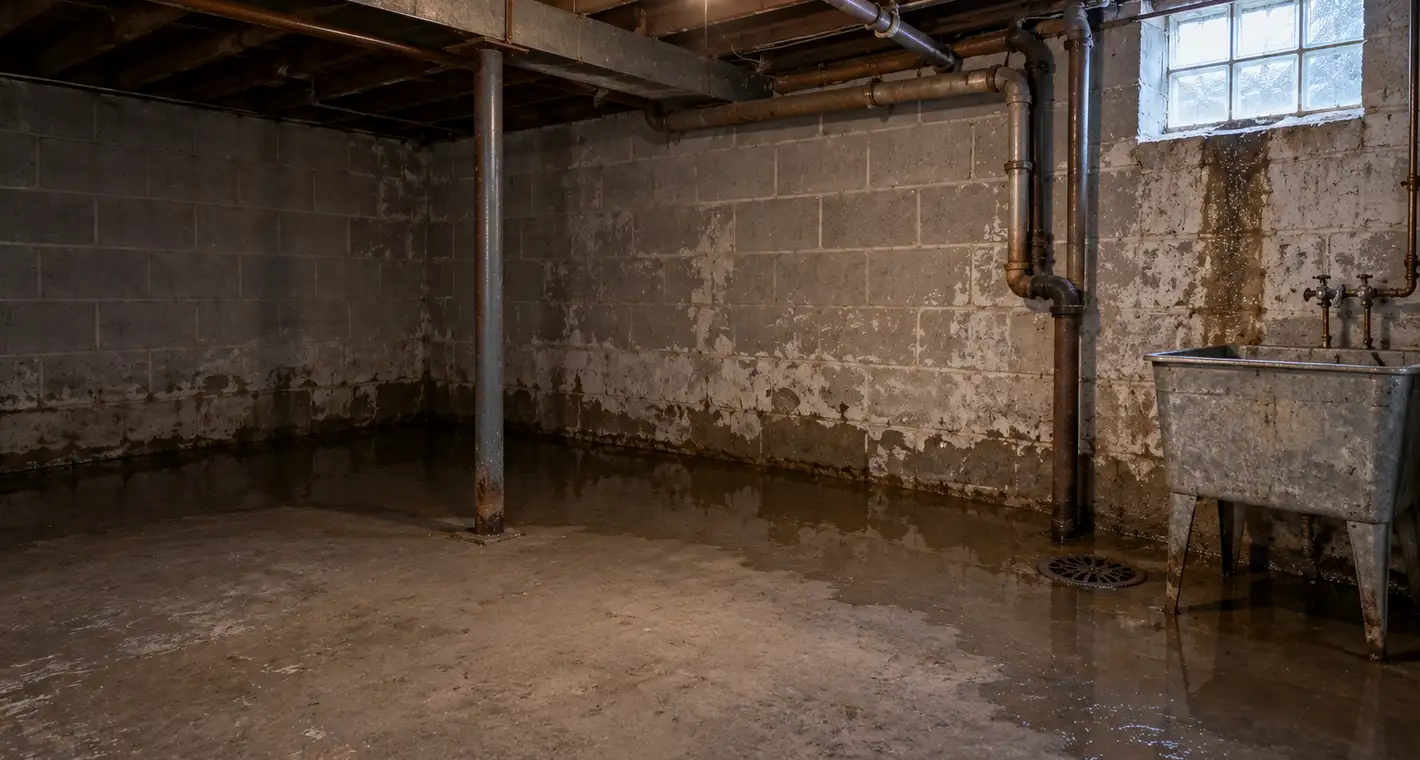
Emergency water removal Eastpointe: the ground and what is built on it
Eastpointe is a compact grid on the southern edge of Macomb County, flat and fully built out, and all of it drains through a combined sewer to the Chapaton retention basin at the foot of Nine Mile Road on Lake St. Clair. Nearly four houses in five here were standing before 1960, forty-six percent of them built in the 1950s alone, and the median year built is 1954. Lots are narrow, houses are small brick bungalows and ranches, and almost every one of them has a full basement under it.
Before help arrives
- Shut the water off at the fixture or the main if you can reach it safely.
- Keep out of any room where water has reached outlets, cords, or the electrical panel.
- Lift furniture off wet carpet and move what you can to a dry floor.
- Photograph the damage and the failure point before anything is moved.
- Do not use a household vacuum to pick up standing water.
Common causes of water damage in Eastpointe
Everything runs to one basin
The whole city shares a combined sewer with most of St. Clair Shores, ending at the Chapaton basin, which holds roughly 28 million gallons. An inflatable dam in the Eight-and-a-Half Mile relief drain adds about three and a half million gallons of in-system storage. Past that point the surge backs up the laterals, and sewage backup cleanup Eastpointe is the same night's work across many streets at once.
Laterals of the same age on every street
When a city is built in one decade, its private sewer laterals age together. Clay pipe laid in the early 1950s is now past seventy years old, with open joints that admit roots and ground water. That leaking is also what fills the public line during rain, so the same defect that floods one basement contributes to the surge that floods the next street.
Small houses, finished basements
With eight hundred to eleven hundred square feet upstairs, the basement here is not storage; it is a family room, a spare bedroom and the laundry. That means carpet, paneling and often a second bathroom sitting directly on a slab that was poured without a vapor barrier. A backup that would be a mopping job in an unfinished basement becomes a removal job here.
Roof water discharged against the wall
Downspouts on these lots were often tied straight into the sanitary lateral or cut off and left to discharge at the foundation. The first sends roof water into the sewer during every storm; the second saturates the soil against a seventy-year-old block wall. Emergency water removal Eastpointe crews find one or the other on a large share of the houses they enter.
Burst pipe cleanup Eastpointe, and drying what it leaves behind
Basements here are low and tight, with paneling on furring strips against block and carpet glued to bare slab. Both hide water, and burst pipe cleanup Eastpointe on a laundry line against an outside wall leaves the same problem. The paneling and the furring behind it come off where the water was contaminated, and the slab is dried with the room sealed and dehumidified rather than ventilated, since outdoor air in a Michigan summer adds moisture rather than removing it.
The full sequence, and how drying is confirmed rather than assumed, is set out on the water extraction and drying page.
Water damage and mold services in Eastpointe
- Water Extraction & DryingStanding water removal and controlled structural drying under daily moisture readings.
- Basement Flood CleanupBelow-grade water: sump failures, sewer surcharge, seepage through block walls.
- Sewage Backup CleanupContaminated water from floor drains and laterals, handled under containment.
- Mold RemediationGrowth that took hold after water sat longer than it should have.
Areas covered in Eastpointe, MI
Providers cover Eastpointe and the surrounding area, including the Gratiot corridor, Kelly Road, the Nine Mile blocks, the Ten Mile blocks, Beechwood and the Eight and a Half Mile drain.
Water Damage Restoration Eastpointe, MI: questions we are asked
- Is water from a combined sewer backup treated differently?
- Yes. It is handled as contaminated regardless of how it looks, because it carries sanitary waste. Porous material that absorbed it — carpet, pad, paneling, the lower band of drywall, upholstered furniture — is removed rather than cleaned and dried. Hard surfaces are cleaned and disinfected, and the space is dried afterwards. That sequence is the reason these jobs cost more than a clean-water loss of the same size.
- My neighbor has a backwater valve and I do not. Does that matter?
- It matters for their house, not for the level in the street. A valve protects the property it is fitted to by closing when the public line surcharges. It does not reduce pressure elsewhere on the network. If your house is next in line without one, the surge finds your floor drain instead, which is why these installations tend to spread street by street after a bad storm.
- Does water damage restoration Eastpointe MI include the drying afterwards?
- It is the larger half of the job. Removing water and contaminated material takes hours; bringing block walls, framing and a slab back to a normal moisture content takes days of air movers and dehumidifiers with readings logged each day. A basement that felt dry underfoot on day two is routinely still wet in the wall base on day four, and that is the material that later grows.
- How often does mold remediation Eastpointe follow a backup?
- Often, when the response was slow. These basements are cool, enclosed and poorly ventilated, and paneling on furring strips creates a gap that stays damp. Material dried within the first two or three days usually avoids growth. Material left behind paneling for a week generally does not, and at that point the work becomes containment and removal rather than drying.
- Why do so many Eastpointe basements flood on the same night?
- Because the city drains as one unit. Street water and sewage share the same pipe here, and all of it runs to a single retention basin at the lake. When the basin and the relief drain are full, level rises across the whole network rather than in one neighborhood, and every basement drain connected to it sees the same pressure. It is a capacity event, not a series of individual plumbing failures.