
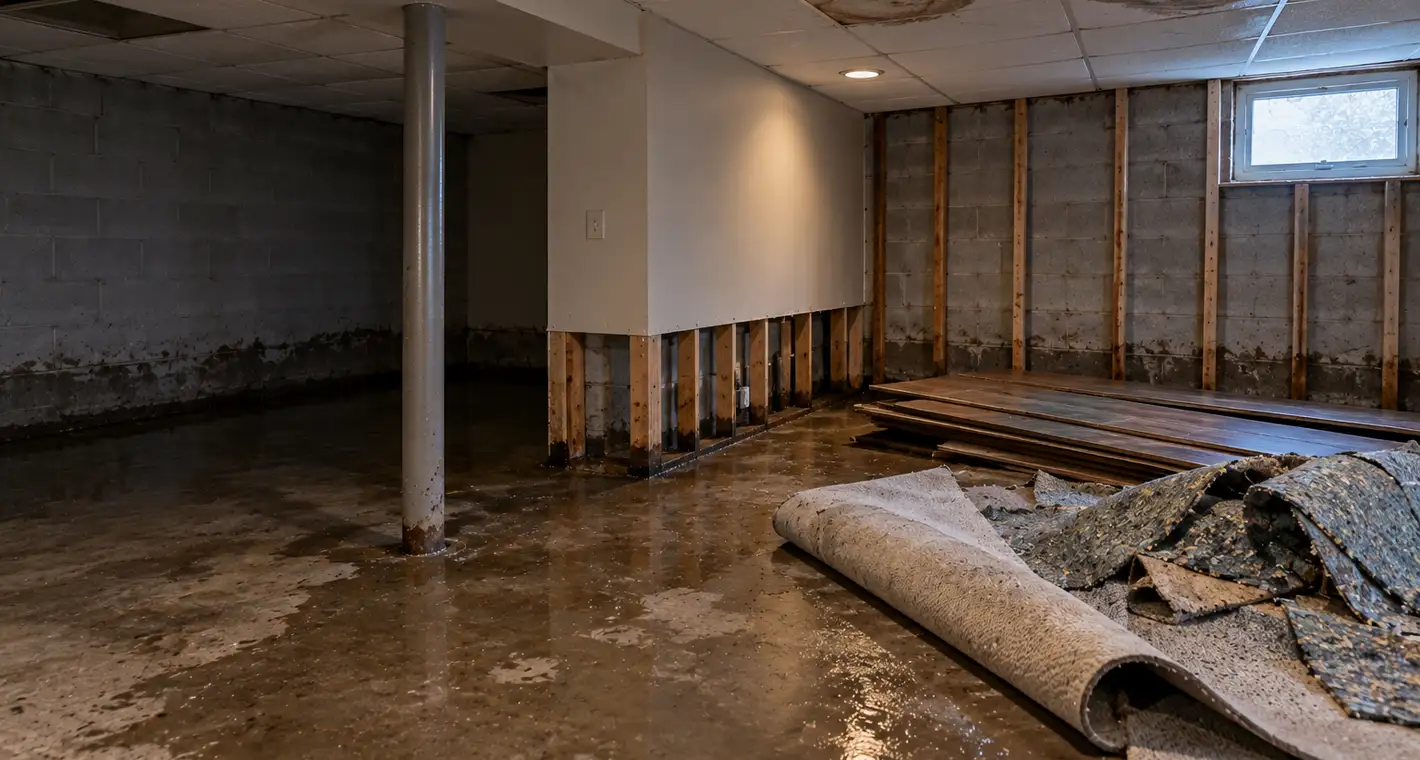
Flooded basement cleanup Macomb County: four ways water gets in
Up through the floor drain
The drain in the basement floor is the opening closest to the floor on the property, so a sewer under pressure releases there first. On the combined systems that serve Ferndale, Hazel Park, Royal Oak, Madison Heights, Eastpointe, Roseville and St. Clair Shores this happens during rain. On the separate systems in Warren, Sterling Heights and Fraser it happens when groundwater has leaked into the sanitary line upstream.
Sump pump failure in a saturated pit
Subdivisions built from the 1970s onward drain their footings to a pit and a pump. A quarter of Michigan households have gone a day or more without power, and a pit in saturated clay refills in under an hour, so the outage itself is the flood. The winter version is a discharge line frozen shut in the last few feet outside, which stalls the pump without any outage at all.
Through the cove joint in the wall
Houses built before perimeter drain tile became standard have bare soil against block. When the yard saturates, water enters through mortar joints and through the seam where the wall meets the slab, leaving a wet band around the perimeter and a drier middle. Pre-war Ferndale, Royal Oak and Hazel Park see this constantly, and no interior coating changes the pressure on the far side of the wall.
In at a window well or a walkout
A window well with a blocked drain fills like a bucket and pushes the glass in. A walkout or daylight door on a sloping Troy lot takes sheet water across the threshold once the trench drain clogs. Both put surface water straight onto a finished floor, and water that crossed the ground is treated as unclean.
Why the outage matters more than the rain
The statistic that shapes this work is not rainfall. It is that twenty-five percent of Michigan households have gone twenty-four hours or longer without electricity, and that the storms which saturate the ground are the ones that bring the lines down. A sump pump is an electrical appliance sitting at the bottom of the house, doing the one job that cannot pause. When it stops in the hour the ground is wettest, the basement floods for a reason with nothing to do with plumbing.
That argues for a backup arrangement rather than a bigger pump, and for checking the discharge line outside: it is frozen, crushed or buried more often than the pump is worn out.
What happens on a basement flood cleanup
Category is established first, because it decides everything after it. Clean water from a supply line allows most material to be dried in place. Water that came up a floor drain, or crossed the ground outside, is contaminated however it looks, and porous material that absorbed it is removed.
Contents come out early: a basement packed with boxes will not dry evenly however long the equipment runs. After extraction the removal list is predictable — carpet padding, the lower band of drywall, wet insulation, paneling and its furring, particleboard, any laminate the water reached.
Drying follows, and block sets the schedule. Water sits in the hollow cores and leaves through the face slowly, so readings are taken at two heights and compared against a dry section of the same wall. Equipment stays until they match, which for a contained basement loss runs three to five days, longer where paneling stayed up or the water sat over a weekend.
The part that is outside the house
A basement that floods through the wall has a drainage problem in the yard, and drying the room is only half of it. The usual findings are downspouts discharging a foot from the foundation, grade falling back toward the house, a window well with no working drain, and on narrow Hazel Park and Eastpointe lots the roof water of two houses landing in one strip of soil. None of that is restoration work, but a crew that says nothing about it is leaving the loss to repeat.
Flooded basement cleanup by city
- Flooded Basement Cleanup WarrenZIP 48088, 48089, 48091, 48092, 48093
- Water Damage Restoration Sterling HeightsZIP 48310, 48312, 48313, 48314
- Water Damage Restoration St. Clair ShoresZIP 48080, 48081, 48082
- Water Damage Restoration TroyZIP 48083, 48084, 48085, 48098
- Water Damage Restoration Royal OakZIP 48067, 48073
- Water Damage Restoration EastpointeZIP 48021
- Water Damage Restoration RosevilleZIP 48066
- Water Damage Restoration FraserZIP 48026
- Water Damage Restoration Madison HeightsZIP 48071
- Water Damage Restoration FerndaleZIP 48220
- Water Damage Restoration Hazel ParkZIP 48030
Basement flood cleanup Macomb County: questions we are asked
- The power went out and the basement flooded. Is that common here?
- It is one of the most frequent patterns in Michigan. A quarter of households in this state have gone without electricity for a full day or longer, which is the worst record of any state this network works in. A sump pit in wet ground refills in well under an hour, so a pump that stops has flooded the floor long before the lights come back on. Battery and water-powered backups exist for exactly this failure.
- Water in basement after heavy rain: seepage or a sewer backup?
- Look at where the water is. A sewer surcharge comes up through the floor drain and spreads outward from it, and it is usually contaminated. Seepage arrives through the joint where the wall meets the floor and leaves a wet band around the perimeter with a drier middle. The two need different responses, and the second one is a drainage problem outside the house rather than a plumbing failure inside it.
- What has to come out of a finished basement?
- Carpet padding always, because it holds water and dries too slowly to keep the carpet above it from staying wet. The lower band of drywall and any wet insulation behind it, because a cavity holds water against the back of the board. Paneling on furring strips comes off as well, since the gap behind it is where growth starts. Carpet itself is often salvageable if the water was clean and it is lifted the same day.
- Can block walls actually be dried?
- Yes, but slowly and unevenly, because water sits inside the hollow cores and leaves through the face. Readings are taken at two heights on the same wall and compared with a section of the same block that stayed dry, and a wall that meters dry at knee height can still be wet at the base. This is the material that most often decides how long equipment stays in a basement.
- Is it worth rebuilding a finished basement the same way?
- Not over a wall that has no drainage outside it. Framing, insulation and drywall against untreated block reproduce the same result on the next wet autumn, with the difference that the water is now hidden inside a cavity instead of running across a bare floor. Where the wall cannot be drained from outside, the honest options are a different finish detail or leaving the wall exposed.