
Emergency water removal Royal Oak: the ground and what is built on it
Royal Oak grew up along Woodward on the Oakland County side, and its street water and sewage share one pipe that ends at the George W. Kuhn basin in neighboring Madison Heights before discharging to the Red Run Drain. Almost a third of the housing predates 1950 and sixteen percent predates 1940, with another twenty-nine percent from the 1950s. The median year built is 1956. The classic block is a small pre-war bungalow on a narrow lot, often with a dormered attic and a stone or block basement.
Before help arrives
- Shut the water off at the fixture or the main if you can reach it safely.
- Keep out of any room where water has reached outlets, cords, or the electrical panel.
- Lift furniture off wet carpet and move what you can to a dry floor.
- Photograph the damage and the failure point before anything is moved.
- Do not use a household vacuum to pick up standing water.
Common causes of water damage in Royal Oak
One pipe for rain and sewage
Royal Oak is one of fourteen communities whose combined sewage runs into the George W. Kuhn retention basin, a 150-million-gallon structure under the freeway at Twelve Mile. When rain fills the basin faster than it drains, level rises in the same public line your basement drain connects to. Sewage backup cleanup Royal Oak is therefore a rain-driven job here, not a plumbing fault inside the house.
Pre-war basements built before drain tile
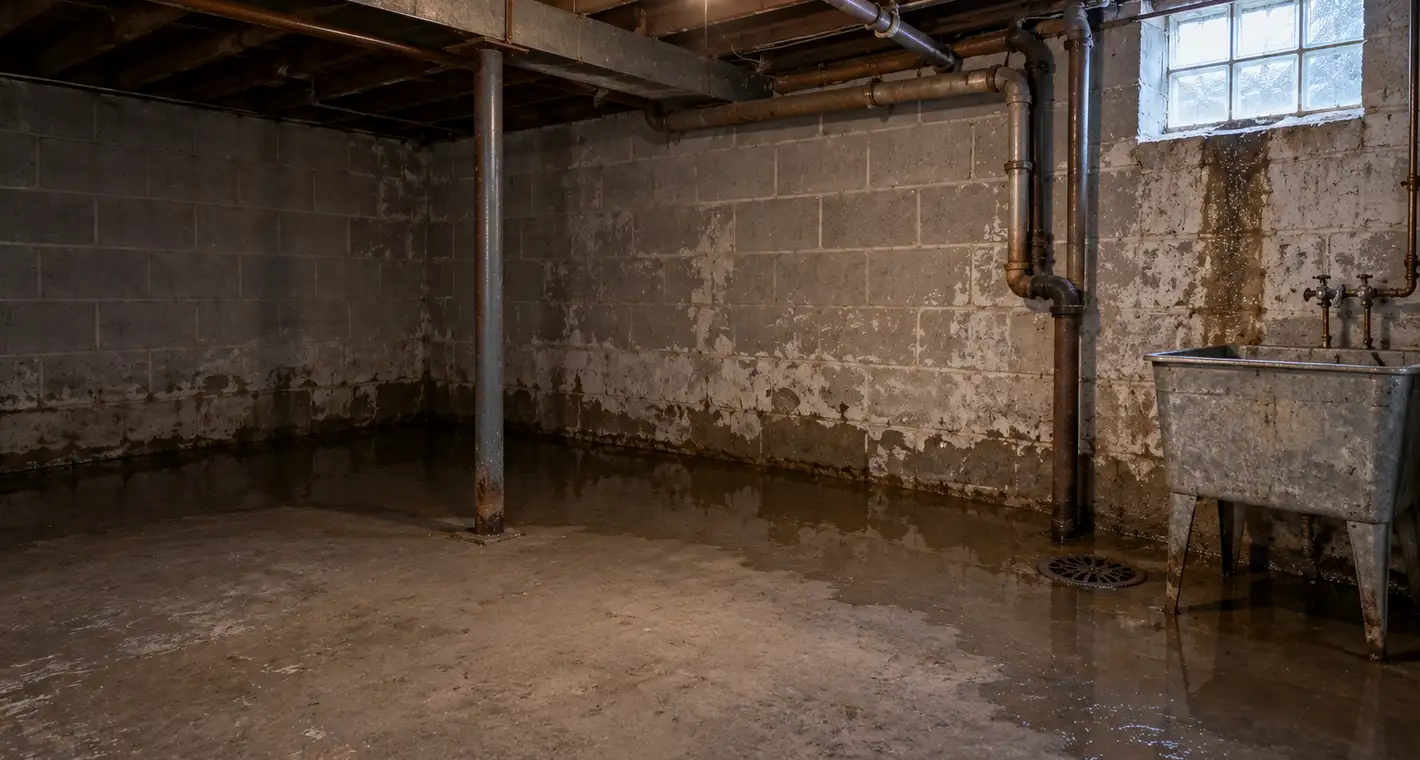
A bungalow from the 1920s was built with a shallow block or stone foundation, no perimeter drain tile and no sump. Water that reaches the outside of that wall enters through the mortar joints and the cove where wall meets floor. Renovations added finished rooms downstairs without changing any of that, so the water now arrives into carpet and drywall instead of onto a bare slab.
Galvanised and lead-jointed lines still in service
Houses of this age keep original galvanized steel supply runs in places, and the corrosion is inside where you cannot see it. They fail at a seam or a threaded joint rather than in the middle of a run. Burst pipe cleanup Royal Oak most often starts at a laundry or a kitchen branch that was never replaced during a cosmetic remodel.
Deep additions on shallow foundations
Many houses here have been extended to the back of the lot. Where the addition sits on a slab or a crawl space against an older basement, the joint between the two moves and opens. Water travels along it, appearing in the original basement several feet from where it entered. Emergency water removal Royal Oak on these houses starts by finding that seam.
Burst pipe cleanup Royal Oak, and drying what it leaves behind
Stone and block foundations release moisture slowly and unevenly, so a wall that meters dry at one point can be wet a foot away. Older plaster over lath holds water differently from drywall and often survives if it is dried promptly. Where a basement was finished over an untreated wall, the finish is removed rather than dried, because it will re-wet at the next rain.
The full sequence, and how drying is confirmed rather than assumed, is set out on the water extraction and drying page.
Water damage and mold services in Royal Oak
- Water Extraction & DryingStanding water removal and controlled structural drying under daily moisture readings.
- Basement Flood CleanupBelow-grade water: sump failures, sewer surcharge, seepage through block walls.
- Sewage Backup CleanupContaminated water from floor drains and laterals, handled under containment.
- Mold RemediationGrowth that took hold after water sat longer than it should have.
Areas covered in Royal Oak, MI
Providers cover Royal Oak and the surrounding area, including downtown Royal Oak, Vinsetta Boulevard, the Woodward corridor, Northwood, Normandy Oaks and the Eleven Mile blocks.
Water Damage Restoration Royal Oak, MI: questions we are asked
- Should I put a backwater valve on a pre-war house?
- It is the standard answer to this failure and it works, with two caveats specific to old housing here. The lateral often has to be located and partly replaced to install one, because it is clay and shallow. And once the valve closes, anything you run inside the house has nowhere to go, so households usually pair it with the habit of not using water during the worst of a storm.
- The basement wall weeps at the floor. Is that the sewer too?
- No, that is ground water and it is a separate problem. A bungalow built before perimeter drain tile has nothing outside the wall to intercept water, so a saturated yard pushes it through the cove joint. It appears as a wet band around the perimeter with a dry center, usually a day or two after the rain rather than during it.
- Is water damage restoration Royal Oak MI different in a finished basement?
- The decisions are harder. On a wall with no exterior drainage, finish material acts as a sponge that will wet again at the next storm, so drying it in place is a short-term result. Carpet, pad and the lower band of drywall come out, the wall is dried and monitored, and the conversation turns to whether the finish should be rebuilt the same way.
- How common is mold remediation Royal Oak after a wet basement?
- Common enough that it drives the schedule. Pre-war basements have low ceilings, limited air movement and cool surfaces, which is a combination that keeps material damp for a long time. Growth on the back of paneling or inside a stud bay is routine here and is handled by containing the area and removing the affected material rather than by treating the surface.
- Why does my Royal Oak basement back up during rain and not otherwise?
- Because the city is on a combined sewer. Rain that falls on streets and roofs enters the same pipe that carries household waste, and during a heavy hour the level in that pipe rises above your basement floor. The retention basin at Twelve Mile exists to hold that surge, but its capacity is finite. Nothing has failed inside your house; the public line simply filled first.