
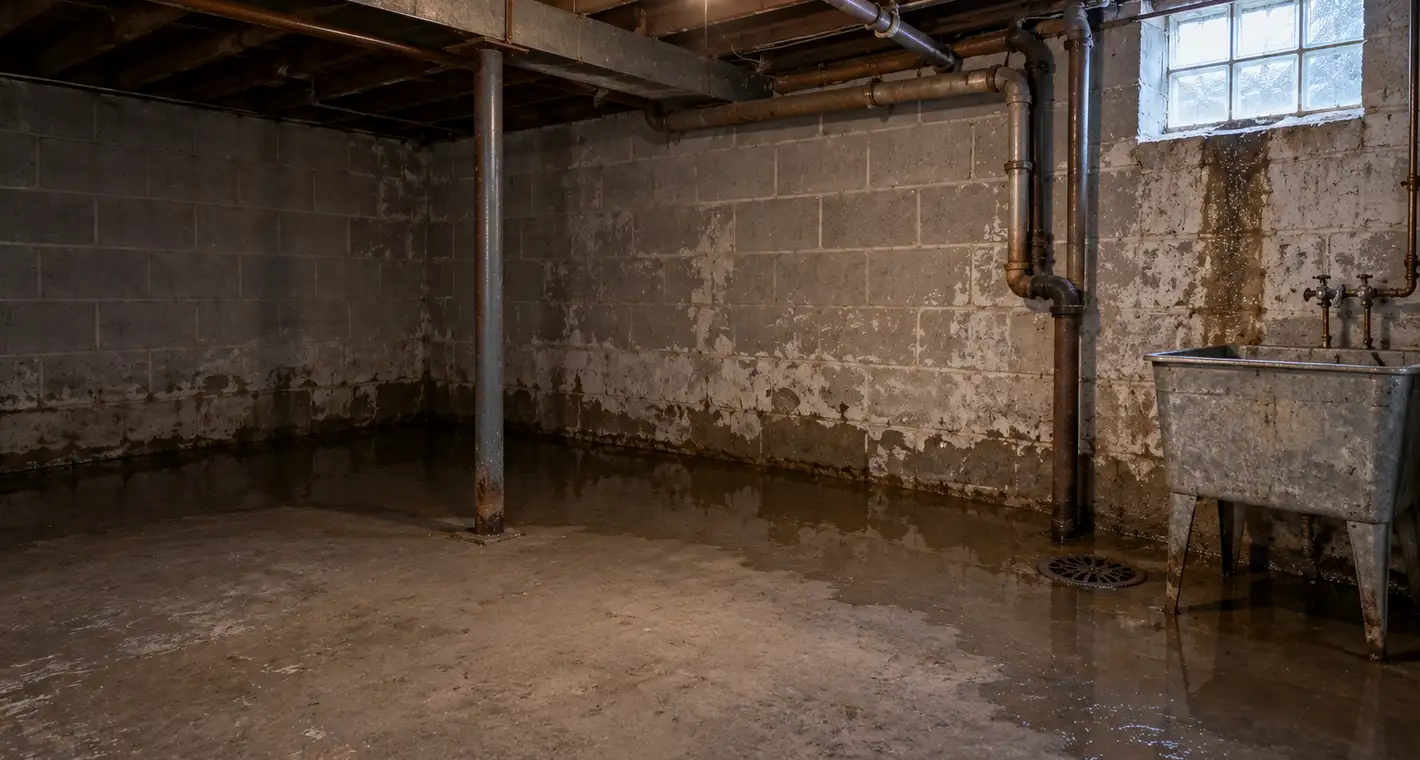
Emergency water removal Madison Heights: the ground and what is built on it
Madison Heights is three miles wide between John R and Dequindre, and the largest piece of drainage infrastructure in the whole coverage area sits underneath it: the George W. Kuhn basin, beneath the freeway at Twelve Mile Road. Four houses in ten were built in the 1950s, another one in six in the 1960s, and the median year built is 1961. The typical house is a small brick ranch on a narrow lot with a full basement, and about a third of the city's households rent rather than own.
Before help arrives
- Shut the water off at the fixture or the main if you can reach it safely.
- Keep out of any room where water has reached outlets, cords, or the electrical panel.
- Lift furniture off wet carpet and move what you can to a dry floor.
- Photograph the damage and the failure point before anything is moved.
- Do not use a household vacuum to pick up standing water.
Common causes of water damage in Madison Heights
The city sits over the basin
The Kuhn facility stores and treats combined sewage from fourteen southeast Oakland communities across 24,500 acres and holds up to 150 million gallons before discharging to the Red Run Drain. Madison Heights is one of those communities and it is where the structure physically sits. When upstream flow fills it, the level rises in the same lines local basements drain into, and sewage backup cleanup Madison Heights follows.
1950s laterals under a narrow lot
Clay laterals of this age run only twenty or thirty feet from the house to the main, but they pass directly under a driveway and a street tree. Root intrusion and settled joints are the norm rather than the exception. The blockage is often close enough to the house that a backup fills the basement quickly, before anyone upstairs notices that a fixture is draining slowly.
Rental stock and delayed reporting
With a third of households renting, a basement leak is often reported hours or days after it starts, because nobody was using the space. Time is the variable that decides whether a loss is a drying job or a removal job, so the same failure costs far more here than in an owner-occupied house where somebody was doing laundry that evening.
Furnace and water heater in the wet zone
In a small ranch the mechanicals sit on the basement floor beside the drain, which is the point where a backup arrives. Even a few inches of water reaches burner assemblies and control boards, and burst pipe cleanup Madison Heights on the laundry line above them does the same thing. Emergency water removal Madison Heights therefore starts with cutting power and gas at the source rather than with extraction, because that equipment is not safe to run afterwards.
Burst pipe cleanup Madison Heights, and drying what it leaves behind
Basements here are small, low and full of mechanical equipment, so there is rarely room to set air movers in a clean circuit. Equipment is placed to move air along walls and around the furnace rather than across open floor, and stored contents come out first, because a crowded basement will not dry evenly however long the machines run.
The full sequence, and how drying is confirmed rather than assumed, is set out on the water extraction and drying page.
Water damage and mold services in Madison Heights
- Water Extraction & DryingStanding water removal and controlled structural drying under daily moisture readings.
- Basement Flood CleanupBelow-grade water: sump failures, sewer surcharge, seepage through block walls.
- Sewage Backup CleanupContaminated water from floor drains and laterals, handled under containment.
- Mold RemediationGrowth that took hold after water sat longer than it should have.
Areas covered in Madison Heights, MI
Providers cover Madison Heights and the surrounding area, including the John R corridor, Dequindre Road, the Twelve Mile corridor, Red Oaks, Civic Center Drive and the Thirteen Mile blocks.
Water Damage Restoration Madison Heights, MI: questions we are asked
- Water reached the furnace. Can it be dried and restarted?
- Not by a restoration crew, and not by guessing. Once water has reached burners, gas valves or control boards, the appliance has to be inspected by a qualified heating contractor, who will usually condemn submerged controls rather than dry them. The same applies to a water heater with a submerged gas valve. Plan for that assessment as part of the job rather than as a surprise afterwards.
- I rent. Who arranges the cleanup?
- The building owner is normally responsible for the structure and for arranging remediation, while the tenant's own contents are a separate matter. Practically, the first call still needs to be made by whoever is standing in the water, because the delay while responsibility is settled is what turns a drying job into a removal job. Document the water level and the affected belongings before anything moves.
- Does water damage restoration Madison Heights MI include the basement contents?
- Structure and contents are handled together but under different rules. Anything porous that absorbed sewage-contaminated water is removed; hard surfaces are cleaned and disinfected. In a small basement packed with storage that is a large volume, and clearing it is often the first hours of the job, because the equipment cannot dry a room it cannot circulate air through.
- How likely is mold remediation Madison Heights afterwards?
- Higher than average, for a structural reason. These basements are low, tight and cool, with mechanical equipment blocking airflow, so material dries slowly even with equipment running. Growth becomes likely once material has stayed damp for several days. The reliable way to avoid it is not treatment after the fact but getting the wet material out and the dehumidifier in on the first day.
- The Kuhn basin is here. Why does the city still get backups?
- Because the basin is sized for the upstream network rather than for any single storm. It holds and treats combined flow from fourteen communities before releasing it to the Red Run Drain, which reduces how often the system overflows but cannot remove the peak entirely. During a heavy hour the level in local combined sewers still rises, and the opening it finds is a basement floor drain in one of the cities it serves, including this one.