
Emergency water removal Sterling Heights: the ground and what is built on it
Sterling Heights straddles two drainage basins: about seven-tenths of the city runs east to the Clinton River, the rest south-west into the Red Run Drain, which the USGS gauges where it crosses Fifteen Mile Road. The Clinton River itself cuts the north end at Dodge Park. This is the newest large city in the coverage area. The median year built is 1977, twenty-nine percent of the housing went up in the 1970s alone, and building continued through the 1990s and 2000s, so basements here were poured to later drainage standards than anything to the south.
Before help arrives
- Shut the water off at the fixture or the main if you can reach it safely.
- Keep out of any room where water has reached outlets, cords, or the electrical panel.
- Lift furniture off wet carpet and move what you can to a dry floor.
- Photograph the damage and the failure point before anything is moved.
- Do not use a household vacuum to pick up standing water.
Common causes of water damage in Sterling Heights
A sump pump doing the work the soil will not
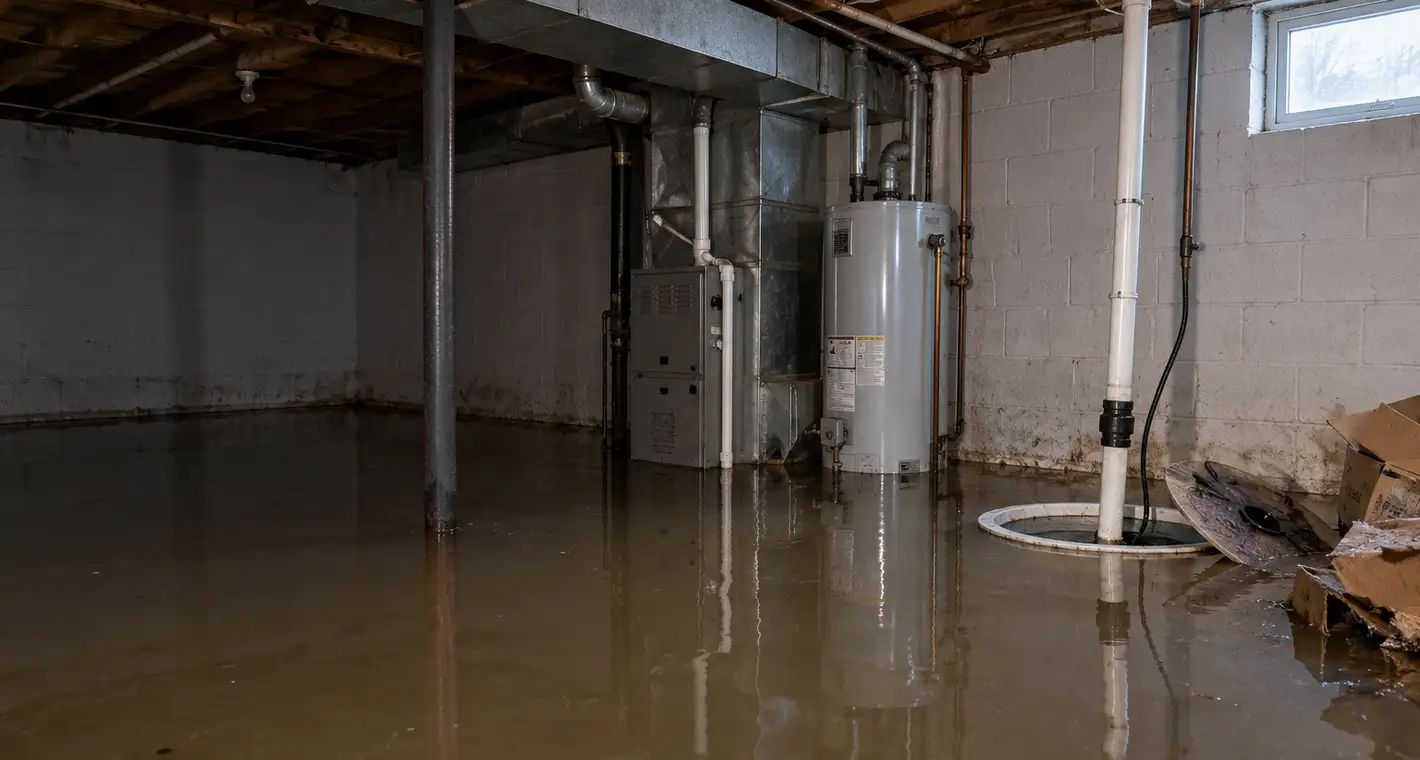
Subdivisions built here from the 1970s on drain the footings to a pit and a pump rather than to a gravity line, because the clay under them takes water slowly and the outfall is far away. That works until the pump does. A quarter of Michigan households have gone a full day or more without electricity, and a pit that fills in ninety minutes does not care why the power is off.
Riverine ground at the north end
The Clinton River crosses the north end of the city past Dodge Park, and the Red Run, Plumbrook Drain and Beaver Creek carry the rest. Streets near those channels sit on ground that is already saturated when a storm starts, so water enters the block wall through the joint between wall and floor instead of coming down the stairs. Emergency water removal Sterling Heights calls from those blocks arrive hours after the rain stops.
Copper and PEX both fail, differently
A 1970s house here still has its original copper, thinned by fifty years of water; the 1990s and 2000s houses have plastic supply lines with crimped fittings at every turn. The copper gives up at a pinhole that weeps into a wall for months. The plastic lets go at a fitting all at once. Burst pipe cleanup Sterling Heights covers both, and the second kind floods two floors in an evening.
Second-story laundry over finished space
Newer subdivisions moved the washer upstairs, above a family room and a finished basement. A supply hose that lets go there sends water down through two ceilings and into the basement, and the drywall on the way is the part that has to come out. This is the loss that looks small on the upper floor and turns out to have wet three levels of insulation.
Burst pipe cleanup Sterling Heights, and drying what it leaves behind
Newer houses here have more carpet over plywood subfloor and more engineered flooring than the older cities do, and both hold water at the seams while looking dry at the surface. Readings are taken through the subfloor rather than off the surface. Where the loss started upstairs, the ceiling below gets opened at the joist bays instead of being dried shut.
The full sequence, and how drying is confirmed rather than assumed, is set out on the water extraction and drying page.
Water damage and mold services in Sterling Heights
- Water Extraction & DryingStanding water removal and controlled structural drying under daily moisture readings.
- Basement Flood CleanupBelow-grade water: sump failures, sewer surcharge, seepage through block walls.
- Sewage Backup CleanupContaminated water from floor drains and laterals, handled under containment.
- Mold RemediationGrowth that took hold after water sat longer than it should have.
Areas covered in Sterling Heights, MI
Providers cover Sterling Heights and the surrounding area, including the Hall Road corridor, Dodge Park, Utica Road, the Van Dyke corridor, Plumbrook and Delco Park.
Water Damage Restoration Sterling Heights, MI: questions we are asked
- My sump pump ran all night and the basement still took water. Why?
- Either the pump could not keep up with the inflow or the water is not coming through the pit. Check where it is wet: a pump that is losing the race leaves water spreading out from the pit, while seepage through the wall-floor joint leaves a wet band along the perimeter and a dry middle. The second one is a groundwater problem, and running a bigger pump will not change it.
- Is a backup sump pump worth it here?
- For a finished basement in this city it usually is, because the failure mode that causes most of the losses is loss of power rather than a worn-out pump. A battery unit buys several hours at a reduced rate; a water-powered backup runs as long as city pressure holds. Neither helps if the discharge line outside is frozen or crushed, which is worth checking at the same time.
- Does water damage restoration Sterling Heights MI cover new construction too?
- Yes, and newer houses are not easier. They are tighter, so a wet wall cavity does not dry on its own the way a drafty 1950s house sometimes did, and they use more engineered wood, which swells and then delaminates instead of drying flat. The building envelope that keeps heating bills down also keeps moisture inside the assembly until equipment is put on it.
- How soon does mold remediation Sterling Heights become the issue?
- Growth generally needs material to stay damp for two to three days at ordinary indoor temperatures, so the question is decided by response time rather than by the size of the loss. A wall opened and dried on day one rarely becomes a remediation job. The same wall left closed for a week, with insulation holding water against the back of the drywall, usually does.
- Why does Sterling Heights flood differently from the cities to the south?
- Because of when it was built. The older suburbs south of here were platted in the 1950s and drain by gravity into sewers laid at the same time. Sterling Heights filled in from the 1970s onward, on flatter ground further from an outfall, so its subdivisions rely on sump pumps and detention rather than pipe capacity. That shifts the common failure from a surcharged public sewer to a private pump that stopped, and it makes sewage backup cleanup Sterling Heights less routine here than a few miles south.